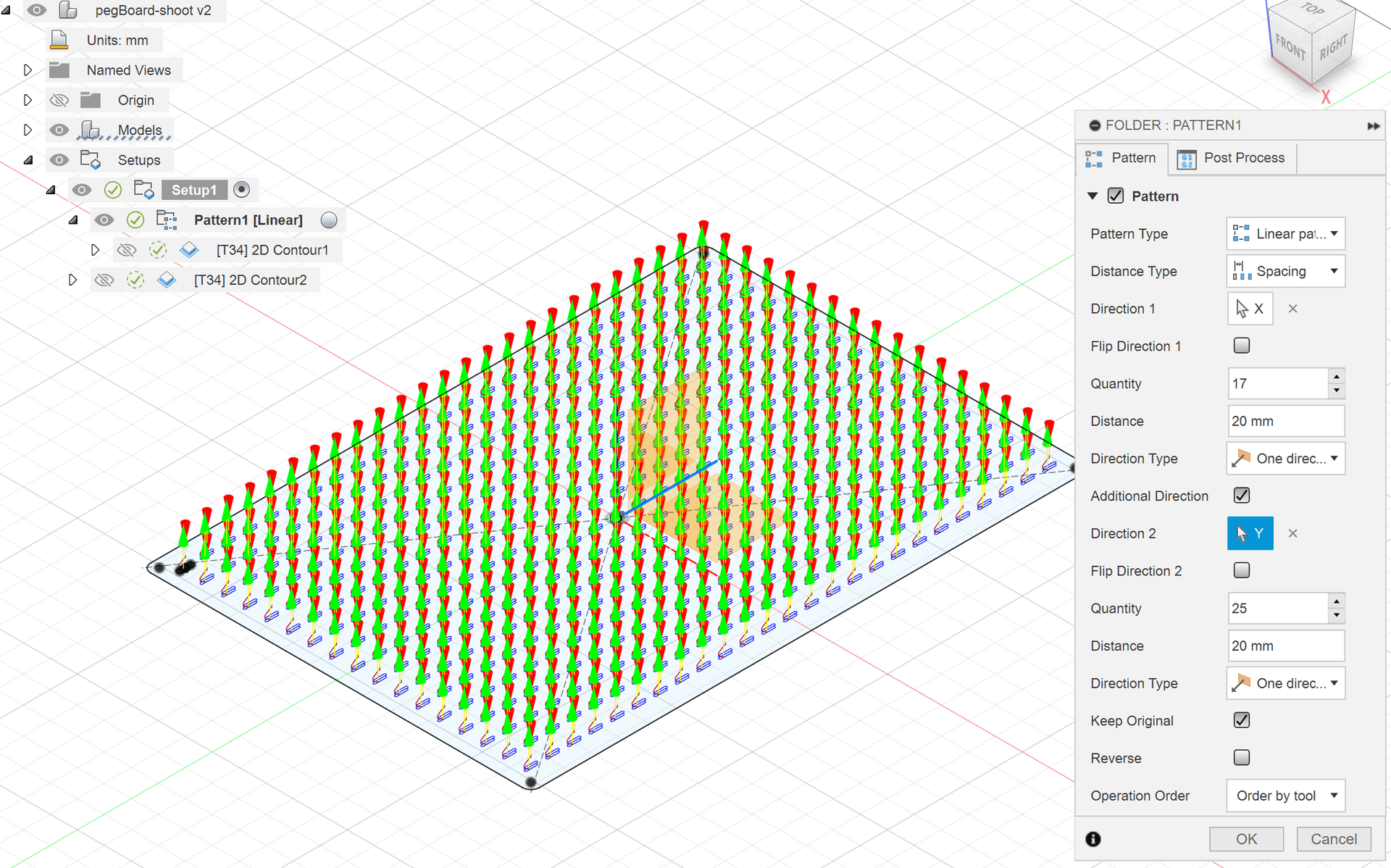
Using Toolpath Patterns in Fusion
Create and machine a parametric pegboard using a toolpath pattern. You will learn how to prepare the design and how to use the Pattern operation in the Manufacture workspace.

Xavier Klein
CNC Educator
This guide is for joiners, cabinet makers and workshop owners considering a CNC to cut panels and wondering what budget to plan for. Our machines serve as examples where useful, and other manufacturers' prices are given where they are public.
For regular professional use on panels, there are now real alternatives that meet the needs of a craftsperson or small business. Industrial ranges are mainly justified for large series production, with semi-automation of the entire chain.
| Range | Typical format | Structure | Spindle | Tool changer | Intended use | Indicative price (excl. VAT) |
|---|---|---|---|---|---|---|
| Hobby / desktop CNC | 300 × 300 to 1000 × 1000 mm | Light aluminium profiles, belts or trapezoidal screws | 0.5 to 1 kW router or small spindle < 1.5 kW | No | Hobby, occasional small batches | €200 to €4,000 |
| Professional workshop CNC (e.g. Mekanika Fab or Luque L series) | 1330 × 2700 mm to 1500 × 3000 mm | Reinforced steel and aluminium, linear guides | 2.2 to 3.5 kW | Option | Series work for craftspeople, cabinet makers, workshops | €12,000 to €25,000 |
| Direct import from China | 1300 × 2500 mm | Welded steel | 3 to 6 kW | Option | Series production, entry price | $5,000 to $25,000 listed, excluding import costs |
| Compact centre from large groups (e.g. Felder Format4 Creator, Homag Centateq) | up to ~1600 × 3200 mm | Industrial | 7.5 to 15 kW | Yes | Industrial series production | On request (no public price) |
| Used industrial machining centre (Biesse Rover, SCM Tech, Homag Venture) | 1250 × 2600 to 2200 × 4300 mm | Heavy industrial | 7.5 to 15 kW | Yes | Industrial series production | €16,000 to €90,000 depending on age, excluding transport |
| New industrial machining centre | 1250 × 2500 to 2100 × 3100 mm | Heavy industrial | 7.5 to 15 kW | Yes | Industrial series production | On request (no public price) |
To cut panels without paying the price of a new industrial machining centre, there are three options: import a machine from China, buy a used industrial one, or choose a new workshop CNC. Here is what each one really costs, and what it involves day to day.
The first option, the cheapest on paper: import a machine directly from China. But the catalogue price of a Chinese CNC is an ex-works price (FOB), in dollars. To know the real cost in Europe, you must add freight, customs duties, import VAT, transport to the workshop, installation and compliance.
| Item | Example for a 1325 machine listed at $8,000 | Good to know |
|---|---|---|
| Ex-works price (FOB) | $8,000, to be converted at the day's rate | Catalogue price in dollars |
| Sea freight + insurance | Reference: $3,504 for a 40-foot container Shanghai → Rotterdam, excluding port charges | A 1325 machine in its crate takes up a 20' container or a share of a 40' |
| Customs duties | 2.7% of the value landed at port (CIF) | TARIC code 8465 92 00 (milling machines for wood) |
| Customs clearance, freight forwarder | ~€400 in handling fees | Have your freight forwarder quote this |
| Transport from port to workshop, unloading | Reference: €2,500 for a Rotterdam → Paris delivery | Machine of 800 kg to 1.5 t |
| Electrical / CE compliance | Reference: €2,000 for a simple complete file (technical file, etc.) | Mandatory before the machine can be put into service |
| Delivered-to-workshop cost | €15,540 excl. VAT | |
| Import VAT | 20% (France), calculated on CIF value + duties | Recoverable for a professional, but must be advanced |
All in, you end up at prices close to those of European manufacturers, with these additional drawbacks:
Moreover, most Chinese suppliers do not comply with CE conformity or the new EU Machinery Regulation (EU) 2023/1230: with a direct import, you, the importer, bear responsibility for the compliance of the machine you place on the market. This has consequences for your insurance and, if you have employees, for your liability as an employer.
A Chinese CNC can be a good choice for a workshop that already has a competent in-house machine technician who can handle maintenance and repairs. For a craftsperson who depends on their machine every day, the cost of a downtime of several weeks outweighs the price gap.
The second option: buy a used industrial machining centre. It offers the heavy mechanics and tool changer of a major brand, and sometimes reaches the price of a new workshop machine: from €16,000 to €90,000 excl. VAT depending on age, excluding transport and installation. It is a good deal for a workshop with a technician and space, much less so for a craftsperson equipping themselves for the first time.
| Criterion | Used industrial machine | New workshop CNC |
|---|---|---|
| Purchase price | €16,000 to €90,000 excl. VAT depending on age, ex-works | €12,000 to €25,000 excl. VAT |
| Weight, footprint | 1.7 t and more, moved with a crane | Much lighter (140 kg for a Mekanika Fab), delivered on a pallet, fits through doors |
| Electricity | Three-phase 400 V | Often single-phase |
| Tool changer | Yes | Optional or coming later depending on the model |
| Electronics and software | Proprietary, sometimes end of support; licence not always transferable | Recent, open source at some manufacturers such as Mekanika |
| Commissioning | Dismantling, transport, lifting and restart by a technician | Delivery, then kit assembly or assisted self-commissioning |
| Warranty | None or short (dealer) | Manufacturer warranty |
To check before buying a used machine: the age of the CNC control, spindle hours, spare parts availability, condition of the guides, the software licence, and the cost of dismantling, transport and reinstallation.
The third option: a new workshop CNC. Compared with an industrial machining centre, it will mainly be slower (tool changer, automatic loading, spindle power). It keeps, however, the panel format, the precision joinery needs and versatility, for a fraction of the price.
What you keep:
What you lose (or pay for as an option):
For whom the industrial machine remains the right choice: series production of carcasses, several shifts a day, volume that justifies an investment of tens of thousands of euros.
If a new workshop CNC meets your needs, you still have to choose the manufacturer. In Europe, the offer ranges from the machining centres of large groups (Felder, Homag, SCM, Biesse, Holz-Her), sold on quote, to workshop CNC makers (Mekanika in Belgium, Luque in France, Stepcraft, CNC-Step and Sorotec in Germany). To compare like with like, the table below lists, for each, the machine that cuts a full panel (2500 × 1250 mm). Among these manufacturers, Mekanika is the only one to display a public price under €15,000 for a complete machine in this format.
| Manufacturer | Country | Full-panel machine | X × Y travel | Public price |
|---|---|---|---|---|
| Mekanika | Belgium | Fab: workshop CNC kit, open source (vacuum table optional) | 1330 × 2700 mm | €12,000 excl. VAT |
| Stepcraft | Germany | Q.408 ready to use (tool changer and vacuum table optional) | 1223 × 2451 mm | ~€18,600 excl. VAT |
| CNC-Step | Germany | T-Rex 1325: steel frame, three-phase (vacuum table included, spindle optional) | 1300 × 2500 mm | ~€28,800 excl. VAT |
| Luque Machines | France | Luque L series (L1325): steel frame (tool changer optional) | 1300 × 2500 mm | On request (“from €13,500” announced for the range, size not specified) |
| Sorotec | Germany | Alu-Line 2513 Heavy Gantry: mechanics only (motors, electronics, spindle and software extra) | 2550 × 1350 mm | ~€8,500 excl. VAT for the mechanics only |
| Felder Group (Format4) | Austria | Format4 Creator compact centre | Panel format | On request |
| Homag | Germany | Machining centres (Centateq, Venture) | Panel format and larger | On request |
| SCM Group / Morbidelli | Italy | Machining centres and nesting | Panel format and larger | On request |
| Biesse | Italy | Machining centres (Rover, Skill) | Panel format and larger | On request |
| Holz-Her | Germany | Nesting and machining centres (Dynestic) | Panel format | On request |
Whatever the manufacturer, the purchase price is only part of the bill: over 5 years, a CNC also costs money in parts, software, production downtime and support. These costs depend mainly on two things: whether the machine uses standard components, and whether you are free to choose your software.
This is Mekanika's approach: open-source machines with standard parts and published plans, offering the capabilities of an industrial machine at a lower throughput and at a workshop price.
The delivery mode also weighs on the budget. The kit lowers the price and lets you get to know your machine in depth during assembly, which speeds up troubleshooting. Allow 15 hours of assembly for two people for a Fab alone (or 25 hours alone). For our more compact machines: about 6 hours for an Evo, 8 to 10 hours for a Pro.
If you want to see what assembly looks like, you can already browse the step-by-step guides for the Fab, the Pro or the Evo.
Once the machine is chosen, you still have to finance it. A workshop CNC is most often financed through leasing: over 60 months, count a few hundred euros excl. VAT per month for a large-format machine. Public grants can sometimes reduce the bill.
Yes, as soon as you regularly subcontract your cutting. It is generally billed at €50 to €85 excl. VAT per hour, not counting file preparation. With a leasing payment of around €435 excl. VAT, the machine is covered as soon as 5 to 9 hours of subcontracted cutting are avoided per month.
There are also less visible costs of subcontracting, such as round-trip lead times or the impossibility of modifying a part at the last minute. Conversely, owning the machine lets you offer new services (engraving or cutting for other craftspeople).
At Copeaux'nd Co, a joinery near Metz equipped with a Fab, drilling shelf-pin holes used to take entire days with a ruler and template. With the CNC, it now takes less than an hour. At La Source, a Belgian micro sawmill, the CNC opened up new services: “This machine brought us profitability, versatility and the ability to adapt.”
To sum up, here are the questions to ask before investing, so that you have every budget element in mind:
Mekanika is a Belgian company based in Brussels whose ambition is to make local production more accessible thanks to a 100% open-source approach.
We design and produce high quality machines for CNC milling and screen printing, which have been recognized for their reliability and ease of use. Our tools are delivered as kits and fully documented, allowing to easily adapt them to specific needs.
Visit our shop to find out more, or check out our online resources and tutorials to continue learning.
Create and machine a parametric pegboard using a toolpath pattern. You will learn how to prepare the design and how to use the Pattern operation in the Manufacture workspace.
Xavier Klein
CNC Educator
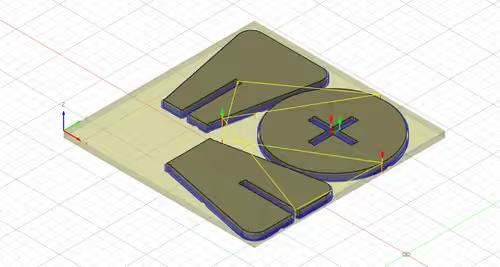
Learn how to design a parametric stool assembled with mortise and tenon and cross lap joints, then prepare its machining in Autodesk Fusion.
Xavier Klein
CNC Educator
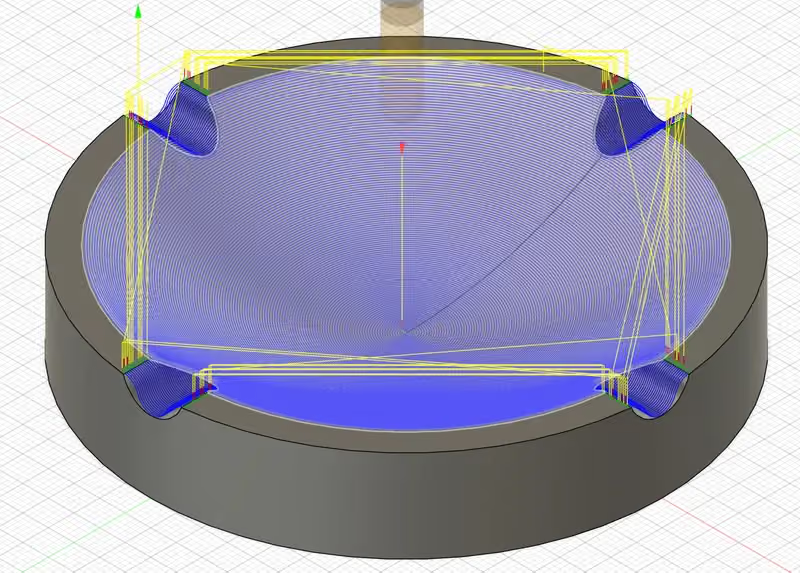
Learn how to model a parametric ashtray and prepare its 3D machining in Autodesk Fusion, from roughing to finishing.
Xavier Klein
CNC Educator